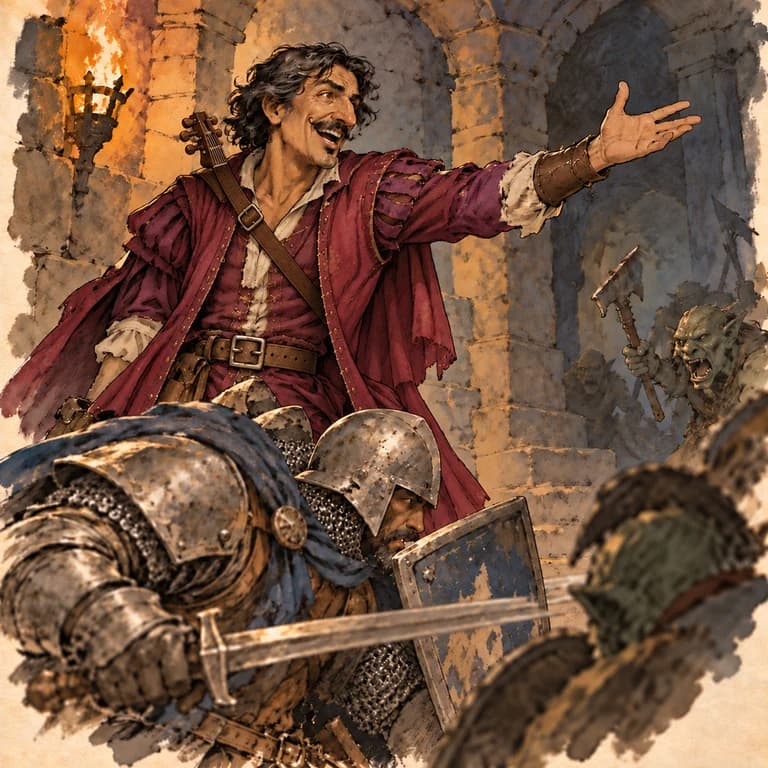
Bard in action

The adventurer’s handbook

Bard

Conductor of the battle

The Bard has discovered that people will attempt extraordinary things if somebody gives them a sufficiently stirring introduction. From behind the fighting line come encouragement, precise directions, and remarks that would start a tavern brawl if one were not already in progress. A good performance keeps the party standing. A great performance persuades the party that this was their idea.

Playing a Bard

Key ability
Charisma
Hit points
1d6 per level, adjusted by Constitution; at least 1 HP gained.
Equipment
Light armor, no shield. Ordinary weapons provide a fallback. Performances require no purchased instrument.

Work from the rear and watch the whole party. Basic performances conserve Inspiration; reserve stronger techniques for a dangerous attack or an ally in trouble. Your healing supply must last the crawl, even when Inspiration returns.

Level progression

Keep the abilities of earlier levels as you gain new ones. XP is experience; the figures below are cumulative thresholds from the beginning of an adventurer’s career.

  1. Level 1

    0 XP

    Rally, Cutting Quip, and Heartening Word. Inspiration 2 per encounter; healing 2 uses per crawl. Bardic Lore.

  2. Level 2

    1,200 XP

    Guiding Verse.

  3. Level 3

    2,400 XP

    Bolstering Refrain.

  4. Level 4

    4,800 XP

    Countersong.

  5. Level 5

    9,600 XP

    Opening Verse.

  6. Level 6

    20,000 XP

    Inspiration increases to 3 per encounter. Guardian and Conductor priority presets.

Abilities and their limits

Performances and Inspiration

Basic performances are unlimited, single-target actions. Stronger techniques share 2 Inspiration per encounter, rising to 3 at level 6. Heartening Word also draws from 2 healing uses for the whole crawl. Performances reach across the active formation; reserve heroes cannot perform. Hearing-based effects require a listener who can hear, and relevant immunities still apply.

Rally

Spend your action to give one ally +1 to its next weapon attack, expiring after its next turn. Bard accuracy bonuses do not stack.

Cutting Quip

Spend your action to needle one hearing, susceptible enemy. If it fails a spell save, it suffers −1 to its next attack, expiring after its next turn. Mindless or otherwise immune creatures are not universal targets for insults.

Heartening Word

Spend your action, 1 Inspiration, and 1 crawl healing use to restore 1d6 plus your Charisma modifier HP to one living ally, minimum 1 and capped at maximum HP. It cannot resurrect the dead.

Bardic Lore

Recall useful reminders about enemy weaknesses and counters your company has already discovered. Companions can still consult essential information without a Bard.

Guiding Verse · level 2

Spend your action and 1 Inspiration to move an ally one legal formation position, or swap the acting order of two willing allies in the same area. Respect space, movement restrictions, and restraints. This grants no extra attack.

Bolstering Refrain · level 3

Spend your action and 1 Inspiration to give an ally 1d6 plus your Charisma modifier temporary HP, minimum 1. These absorb damage and expire after the encounter. They do not stack with other temporary HP; keep the higher remaining amount.

Countersong · level 4

After an ally fails a save against magical fear or charm, spend 1 Inspiration for one immediate reroll. This automatic defensive reaction follows your configured priorities and can occur once per round. Never reroll a reroll; multiple Bards cannot grant repeated rerolls of the same failed save.

Opening Verse · level 5

Spend your action and 1 Inspiration to grant an ally +2 on its next weapon attack. If it hits, add 1d6 damage. This grants no extra attack or turn, and its accuracy bonus does not stack with another Bard bonus.

Practiced Performer · level 6

Choose Guardian or Conductor priorities before each encounter and edit individual priorities to suit your party. Both use the same repertoire and shared pool of 3 Inspiration.

Combat reference

An action is your main choice on a turn. A reaction answers a particular event. An encounter is one battle; a crawl includes all its rooms. Encounter resources return for a new battle, not by reloading a page or returning to the same fight.

AC measures armor defense; lower is better. THAC0 is the attack score needed to hit AC 0 before modifiers; lower is better. Saving throws resist hazards. The table shows the required unmodified saving-throw scores; lower is better. Class abilities and equipment can improve them.

Bard attack and saving-throw progression
LevelTHAC0Death / poisonWandsParalysis / stoneBreathSpells
1191314131615
2191314131615
3191314131615
4191314131615
5171213111413
6171213111413